
Should you outsource your bookkeeping?

How many hours does your bookkeeping take each week, and who looks after it when that person is away? Outsourcing can give you those hours back without losing sight of your numbers. Here is what to weigh up before you decide.
- Outsourcing does not have to mean losing control. Done well, you see more, because the books are kept current
- A bank that looks reconciled is not proof the books are right. Ask how payments are matched, not only whether the bank feed is clear
- With a team, someone else usually knows your file already when your bookkeeper is away
- Compare more than the hourly rate. An employee's fixed costs and contracted hours count too
- Good setup, including how your other software connects to Xero, decides how much work the bookkeeping takes every month
Will I lose control of my books?
It is the most common worry, and in our experience it runs the other way. When one person does the data entry in house, you see what that person has had time to finish. When a team keeps the books current, you can open Xero on any day and see who has paid, who has not and where the money came from.
Outsourcing the bookkeeping does not mean handing over the understanding. The numbers are still yours, and we would rather you understand your reports than simply receive them.
A reconciled bank is not the same as correct books
Clearing every line in the bank feed does not prove the bookkeeping is right. A payment can be matched to the wrong customer, or to the wrong payment method, and still disappear from the reconciliation screen. The bank looks finished. The mistake is still there.
So ask any bookkeeper how they match payments, not only whether the bank is reconciled. We do not force a match just to clear the bank feed. If the right match is not known yet, we leave the payment open until we can match it properly.
What that looked like for one practice
A psychology practice had grown from one site to a second. We started by cleaning up Xero and training the owner. Then the owner asked us to take over the bookkeeping.
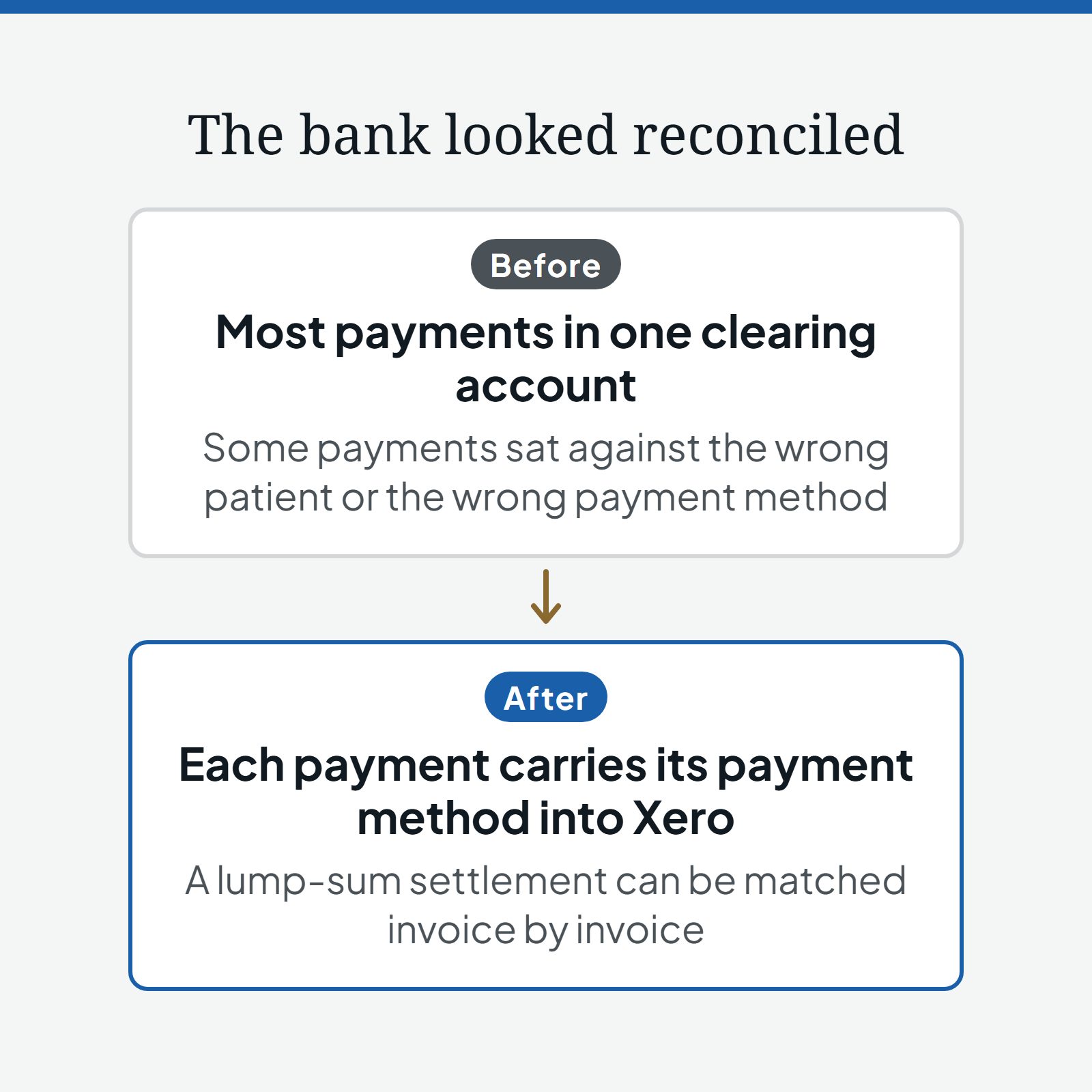
Most payments had been pushed into one clearing account. The bank looked reconciled, but some payments sat against the wrong patient or the wrong payment method, and the clearing account did not balance until a manual adjustment was made.
After a few months, we changed the setup to reduce the bookkeeping hours. Each payment now carries its payment method into Xero, so a lump-sum settlement can be matched invoice by invoice. The same checks showed cash recorded against patient invoices that had not yet been banked. We raised it with the practice manager and the owners, and the money was found and deposited. The practice can now see who has paid and who has not.
Why a team beats one person

A single bookkeeper may need to pass an accounting question to someone else, or may not have the technical background to build an automation. In our team, those skills sit side by side: bookkeepers with different levels of experience, accounting expertise and integration skills.
There is also continuity. If your only bookkeeper takes leave or resigns, what they know about your file can leave with them, sometimes with little or no handover. We normally have at least two bookkeepers who know each client's file. When one is away, another already knows the job.
Is an in-house bookkeeper cheaper?
On the hourly rate alone it can look that way. A fuller comparison includes the fixed costs of employing someone, and the contracted hours you pay for in a quiet week. An outsourced bookkeeper works when the work is there, not to a fixed roster.
Setup decides how much work the bookkeeping takes
Good bookkeeping depends heavily on how the file is set up. If your integrations and account flows are designed well, the monthly work is much easier. If every payment type goes into one clearing account, it is hard to tell whether anything is matched correctly.
Automation helps too, with a person still checking. One client's invoices were raised in software that does not connect to Xero. Each one arrived by email and was typed into Xero by hand, line by line. Now the email creates a draft Xero invoice by itself, and a bookkeeper checks it before approving it. That means less typing, less time and fewer mistakes, with a person still reviewing each invoice.
What to ask before you outsource
- Who will know my file, and who covers when they are away?
- How do you match payments, and what do you do when you are not sure where one belongs?
- How will I see who has paid and who has not?
- Who helps when the question is about accounting, or about how my other software connects to Xero?
- Which parts do you take on, and which stay with me?
Where we fit
If you want the work off your desk, our bookkeeping and BAS services can cover the whole function: invoices followed until they are paid, payments matched, the bank reconciled, the BAS prepared and lodged, and payroll. Some clients hand over everything. Others hand over only the quarterly work.
For a fuller example, read our outsourced bookkeeping case study. On the client's own reckoning, the same work took 25 to 30 hours a week in house, and now takes 5 to 7.5.
The place to start is a free 30-minute call. Tell us where the month goes, and we will tell you whether outsourcing suits you.
Related plain-English guidance

Bookkeeper or accountant, and who is allowed to lodge what
Ask yourself one question: who currently checks that your bank reconciliation agrees with your bank statement, and...

How to reconcile in Xero, and what the green tick does not tell you
Open Xero and compare the balance on your bank account tile with the balance on your actual bank statement today. If...